


03.01.2025
Dear patients and parents, we would like to remind you that a project to identify rare mutations (NGS sequencing of the cystic fibrosis gene using the CFTR panel) is underway, which is free for Ukrainians. All detailed information can be obtained by calling the Center for Orphan Diseases and Gene Therapy +380 (63) 383 04 21 (mobile, Viber, Telegram).
In the article below, our doctors-scientists from the Okhmatdyt National Research Center explain in detail for whom and why it is so important to take advantage of the opportunity to undergo the examination:
“Cystic fibrosis (CF) is a genetically determined disease caused by pathogenic variants of rearrangements in the gene of the transmembrane regulatory protein CFTR, which leads to dysfunction of the exocrine glands and primarily affects the respiratory system and digestive tract. In Ukraine, cystic fibrosis occurs with a frequency of approximately 1:2200 newborns.

In 2012, cystic fibrosis was included in the neonatal screening program in all regions of Ukraine. Since October 2022, an expanded neonatal screening program has been launched in our country, which has opened up new opportunities in the diagnosis of cystic fibrosis, providing a full molecular genetic analysis of all patients with a positive screening result.
But until 2022, not all patients with cystic fibrosis had the opportunity to undergo a full molecular genetic examination to identify pathogenic variants of rearrangements in the CFTR gene, which did not make it possible to establish their genotype. Information about the genotype is a necessary condition for choosing modern methods of pathogenetic therapy of cystic fibrosis, including the possibility of using a new effective drug TRIKAFTA, which is aimed at patients with the F508del rearrangement variant in the CFTR gene. Therefore, there is a need to further examine all patients with cystic fibrosis to give them the opportunity to receive treatment with new modern drugs.

Since April 2024, with the support of the patient organization of cystic fibrosis patients based on the Center for Orphan Diseases and the Laboratory of Medical Genetics, a program has been launched to examine Ukrainian patients with cystic fibrosis who need it. Molecular genetic analysis of the CFTR gene is carried out using a set of modern methods, such as next-generation sequencing (NGS) using a targeted panel, the method of hybridization for common pathogenic variants (LIPA), and analysis of the coding region and exon-intron boundaries of the CFTR gene using the Sanger sequencing method.
In six months, as part of the program, the Laboratory of Medical Genetics of the National Research and Development Center “OKHMATDYT” of the Ministry of Health of Ukraine has already conducted a molecular genetic study of 66 patients diagnosed with cystic fibrosis. The implementation of such a program in Ukraine does not leave us indifferent and contributes to the quality provision of medical care, as well as saving the lives of many Ukrainian patients with such a severe rare hereditary pathology as cystic fibrosis.
In clinical practice, the possibility of conducting an extended molecular study of the CFTR gene plays a decisive role for the final confirmation of the diagnosis or in the differential diagnosis. Sometimes the symptoms of the disease may not be expressed until a certain age, or may be masked by other conditions, or vice versa, the diagnosis of cystic fibrosis may be made incorrectly.

DNA testing for CFTR gene variants can confirm or rule out the diagnosis of cystic fibrosis, especially in cases where clinical symptoms are ambiguous. It also allows doctors to predict the potential course of the disease, its severity and complications, and plan treatment accordingly. With the development of modern pathogenetic therapy, only knowledge of CFTR gene changes influences the choice of treatment. CFTR modulators, which can improve protein function, work only with clearly defined variants.
It is worth remembering that cystic fibrosis is a hereditary disease and conducting a molecular genetic study allows you to assess the risks for family members and plan future pregnancies. Therefore, conducting a DNA study in patients is important for adequate diagnosis, treatment and prognosis of cystic fibrosis.
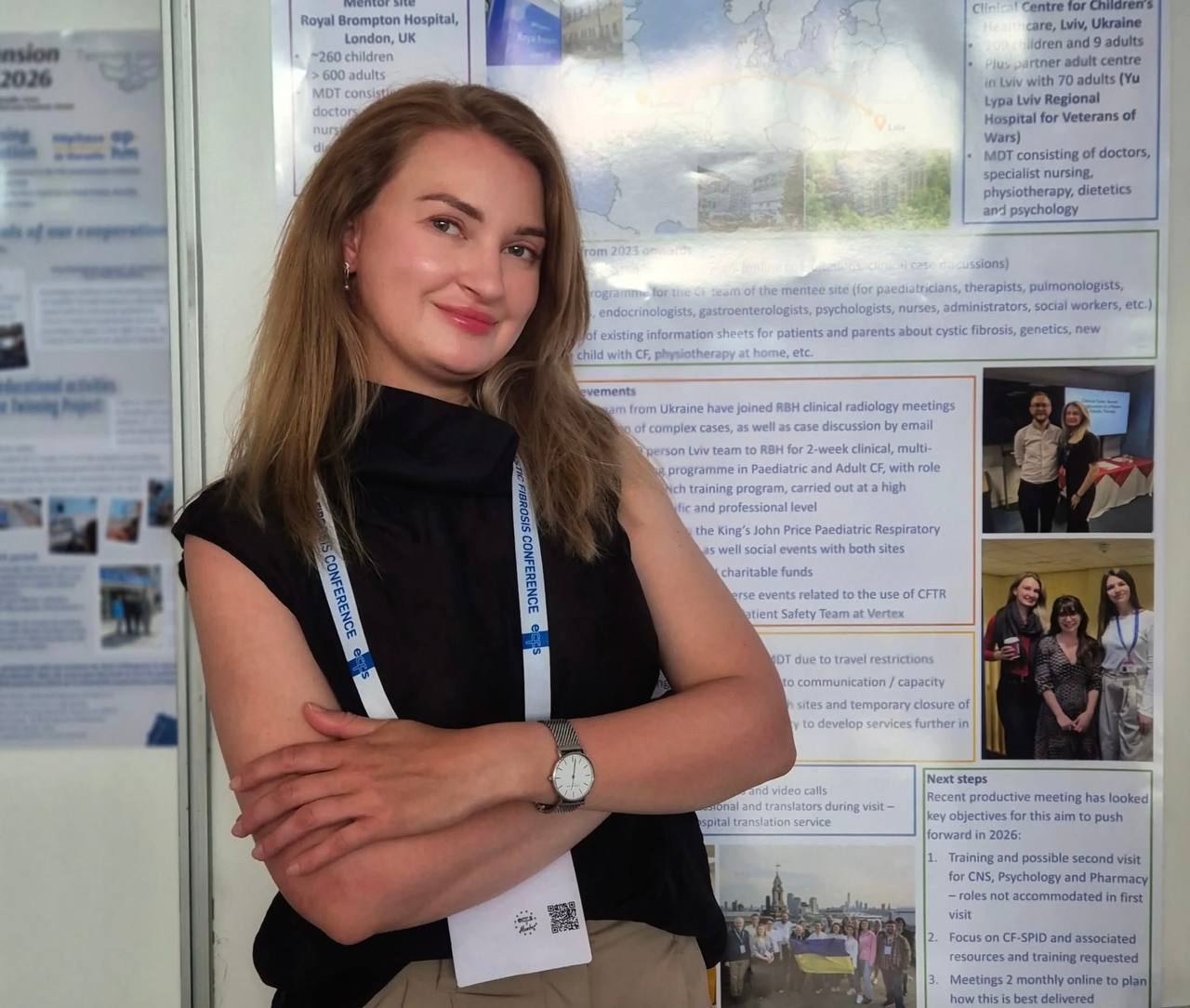
Marta Sheremet – Co-author of an International Publication

Ukraine at the 49th European Cystic Fibrosis Conference

ECFS 2026: New Horizons in Cystic Fibrosis Treatment

49th EUROPEAN CYSTIC FIBROSIS CONFERENCE. LISBON, PORTUGAL

Strengthening the representation of rare disease patients in the Ministry of Health

Charitable Projects Support Program 2026